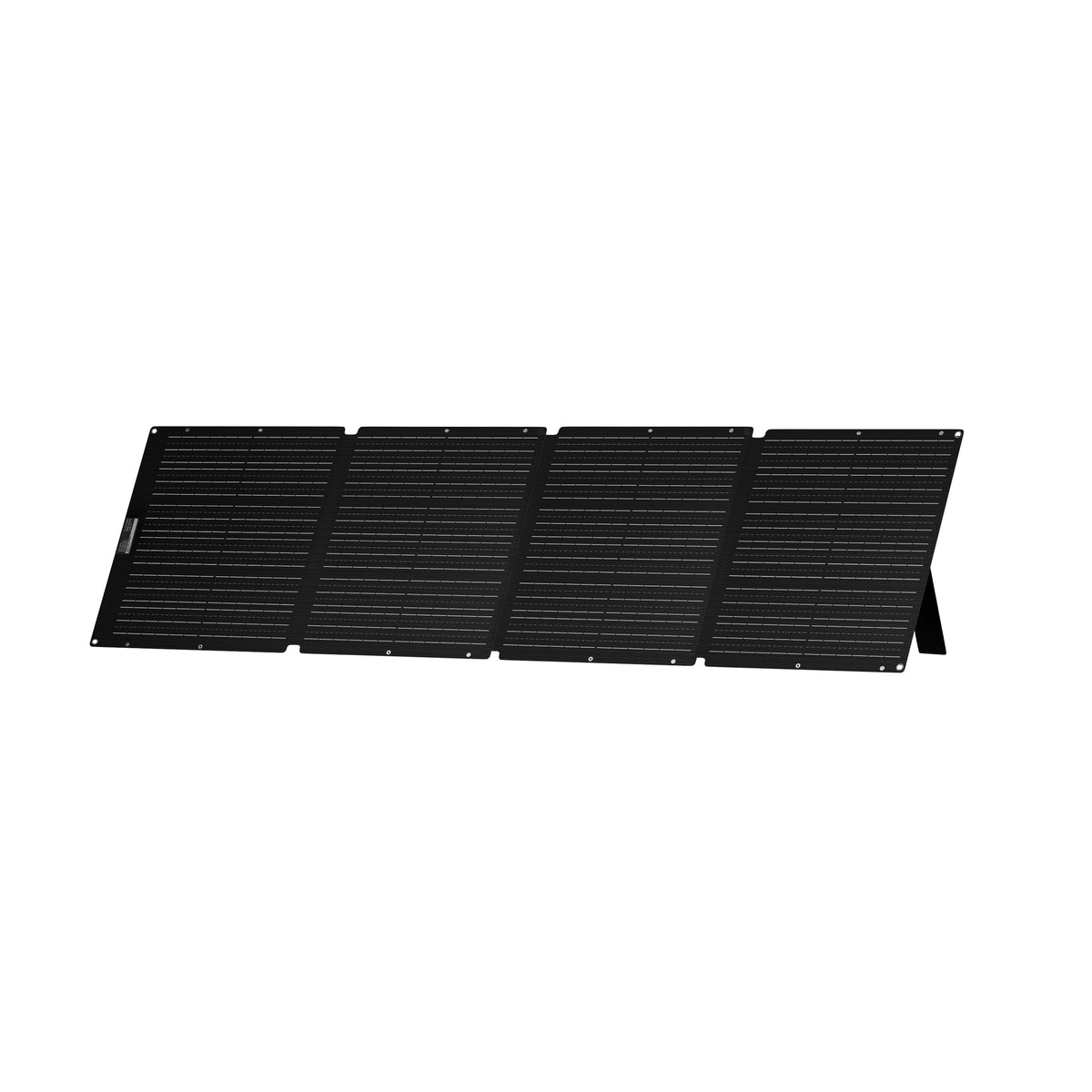
For the camper or off-grid bay that needs recharge speed
By The Numbers
200W
Rated power at STC, ±5%
41.6V
Max power voltage
23–25%
Panel efficiency
7.16 kg
Panel weight
What Sets The SE200 Apart
Higher-Voltage Design
41.6V at maximum power reaches an MPPT window sooner and holds it longer
200W In One Panel
Fewer panels, connectors and cable runs to deploy and pack away by hand

One-Piece Laminate, Not Fabric
No stitched hinges to fail, no sagging, far less route in for moisture
Folds Despite The Output
Array-level recharge without giving up roof space or a mounting commitment
Built For Faster Recharge

Voltage is what buys you the morning
An MPPT controller cannot start until the array clears its minimum voltage, and a low-voltage panel spends the first and last hours of the day below that threshold doing nothing. At 41.6V at maximum power the SE200 clears it earlier and holds it later, and the same power at higher voltage means lower current — which is less loss over a long cable run to the vehicle.
Full Specifications
Every published figure for the SE200, stated at STC
| Rated power (Pmax) | 200W ±5% |
|---|---|
| Open-circuit voltage (Voc) | 48.96V |
| Max power voltage (Vmp) | 41.6V |
| Short-circuit current (Isc) | 5.33A |
| Max power current (Imp) | 4.8A |
| Cell type | Monocrystalline silicon |
| Panel efficiency | 23–25% |
| Surface material | ETFE, one-piece laminate |
| Output connector | MC4 / standard solar connector |
| Weight | 7.16 kg (15.8 lb) |
| Water resistance | IP68 |
| Stand | Adjustable rear bracket, 0–180° |
| Folded dimensions | 559 x 587 x 20 mm (22.01 x 23.11 x 0.79 in) |
| Warranty | 2 years |
Electrical figures are stated at standard test conditions (1000W/m², 25°C cell, AM1.5) with a ±5% power tolerance. Size an array against the tolerance band, not the nominal number.
Frequently Asked Questions
Any station or charge controller whose PV input window covers 48.96V open-circuit and 4.8A. That includes the ALLPOWERS R-series and most third-party stations, but check the maximum PV voltage on yours before connecting — at nearly 49V open-circuit, a single SE200 is already close to the ceiling on some compact stations that top out around 50V. Open-circuit voltage also rises in cold weather, so leave headroom.
Carefully. In series two panels give roughly 98V open-circuit, which exceeds the PV input limit on a good number of portable stations — check before you do it. Parallel is usually the right choice with this panel: two give roughly 49V at 9.6A, three roughly 49V at 14.4A, keeping voltage inside the window while raising current. Match the total against your station’s stated PV input limits for both voltage and current.
Electrically the SE200 behaves like two SE100 panels already wired in series: the same current, roughly double the voltage. That is where the faster charging comes from. If your station has a low maximum PV voltage, two separate SE100 panels in parallel may suit it better than one SE200.
The 200W rating is measured at standard test conditions. In real weather expect meaningfully less. Sun angle, haze, heat and dust all cost output, and a panel left flat rather than angled loses a large fraction of a day’s yield. Use the bracket, aim it, and plan on realistic daily watt-hours rather than the nameplate figure.
Yes. The IP68 rating covers water and dust immersion, so rain, snow and humidity are not a problem. What it will not tolerate is being bent, folded against the laminate or struck by something sharp — the ETFE encapsulation is the weatherproofing, and once it is punctured the rating means nothing.
Build out the rest of the bay
-

ALLPOWERS R2500 Power Station
View productAccepts up to 1,000W of solar, so it can use several of these.
-

ALLPOWERS SE100 100W Foldable Panel
View productThe smaller, lighter option for a compact station or a lower PV ceiling.
-

ALLPOWERS R4000 Power Station
View productTriple solar inputs to 2,000W for a full array of these panels.


Recharge speed you can fold away
- 200W ±5% at STC with 23–25% panel efficiency
- 48.96V Voc and 41.6V Vmp for earlier MPPT start
- One-piece ETFE laminate, IP68 sealed
- Adjustable 0–180° rear bracket, 7.16 kg